

our new album “De Raíz”

In August 2024, the Flirtango Orchestra recorded its first album,“De Raíz“, a refined selection of tangos perfect for both dance lovers and those who simply enjoy listening.
This album brings timeless tango classics back to life with a fresh and contemporary touch, while remaining true to the genre’s authentic roots. The transcriptions and arrangements were crafted by the orchestra’s own musicians, creating a distinctive sound that connects the past and celebrates the present. Additionally, they had the honor of performing the arrangement of the tango Malena by the renowned Argentine tango pianist Javier Lo Re.
The tracks were recorded by Clive Simpson at SoundBetter Studio in Rome.
The mixings, editing and mastering of the songs were taken care of by Paolo Modugno at O.A.S.I Studio, Rome.
The photography and illustration were done by Carla Mulas González.

Gloria, tango 1927.
Music, Humberto Canaro, Uruguay
Lyrics, Armando Tagini, Argentina
Gloria was chosen as the opening track of our album because it represents, in a way, a feminine revenge, despite being written by a man. It is a tango with a feminist touch, revolutionary for its time.
Throughout history, tangos portraying the betrayal of women have abounded, becoming iconic within the genre. This recurring theme might seem like a universal experience, largely due to its widespread popularity through orchestras and singers. However, it is essential to reclaim the value of the female figure and restore her stolen dignity by breaking this cliché. The interpretations that perpetuate the image of the “woman” who deceives the man, plunging him into sadness and despair, are far too many. With this tango, we say enough to this “constant.”

Felicia, tango 1907.
Music, Enrique Saborido, Uruguay
It is said that in 1907, when Saborido first presented his tango, still untitled, fate intervened so that one of the couples dancing it on the salon floor was Carlos Mauricio Pacheco and his wife, Felicia Ilarregui. At the end of the performance, the couple, captivated by the strength and beauty of the piece, approached the composer to learn more about his creation. Saborido admitted he was the author and, in a burst of inspiration, asked Felicia to become the godmother of this tango, “the most tango of all,” as Enrique used to say. Then and there, as naturally as destiny itself, the piece was christened: Felicia.
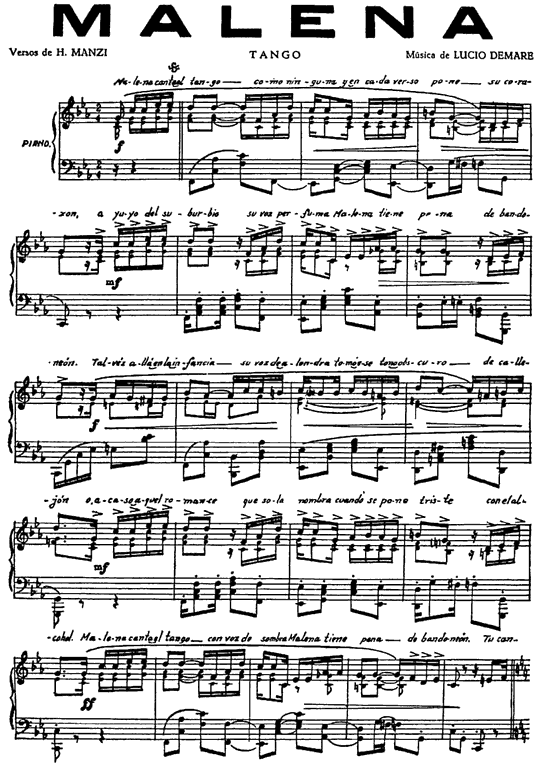
Malena, tango 1941.
Music, Lucio Demare, Argentina
Lyrics, Homero Manzi, Argentina
Homero Manzi, tireless poet and traveler, wandered through bars and taverns in the outskirts of Brazil. In one of them, he discovered a husky voice improvising tangos, accompanied by the guitar. Intrigued, he decided to enter and found a young woman singing. He sat down to listen, and at last, he asked:
—Why do you sing tangos?
The woman replied:
—Because of a lover I lost… and because the music of Buenos Aires captivated me.
That young woman was Malena de Toledo, the stage name of Elena Tortolero, singer and muse of the famous tango according to one of many legends. Malena became one of the compositions that marked the beginning of the mythical 1940s, known as tango’s “golden decade.” Moreover, Homero Manzi had the great merit of definitively introducing poetry into tango through the use of metaphor.
“They say Malena de Toledo had this tango in her repertoire without suspecting it was named after her, and when it was pointed out, she was so overwhelmed that she stopped singing forever.”
(Benedetti, op. cit.).

Invierno, tango 1937.
Music, Horacio Pettorossi, Argentina
Lyrics, Enrique Cadícamo, Argentina
A guitarist and composer. A dreamer poet. Together, they created a legendary tango that has echoed in dance halls and milongas around the world for nearly a century.
Horacio Pettorossi, known as “El Marqués,” devoted his life to the guitar and composing tangos. His dedication led him to collaborate with great figures of the genre while traveling across the globe, leaving an enduring mark on tango history.
Enrique Cadícamo, with 99 years of artistic journey, left us a literary legacy as vast as his famous mane. León Benarós described him as follows:
“An eternal youth, Cadícamo seems to go against the flow of time. He retains his untouched pale blond hair, squared at the nape with a certain youthful abundance… He wears light-colored ties —once we saw him in one of a subtle yellow hue— and his sport jackets add to his youthful air. He wishes to forget about time, because he knows that time —’the dark enemy gnawing at our blood,’ as Baudelaire wrote— feeds on our illusions, on our lives…”
(Enrique Cadícamo, in Tanguera, no. 29, undated).

Yo no sé qué me han hecho tus ojos, vals 1937.
Music and lyrics, Francisco Canaro, Uruguay
They called him “Pirincho”. She was known as “The Empress of Tango.” Yo no sé qué me han hecho tus ojos, a waltz composed by Canaro, was dedicated to the singer Ada Falcón, who always held the role of the musician’s lover. The Empress of Tango left her unmistakable mark on the song, and “a tear escaped her” every time she sang it live.

Remembranza, tango 1934.
Music, Mario Melfi, Argentina
Lyrics, Francisco Canaro, Uruguay
We find ourselves in the era of the “Nueva Guardia” (1920-1940), a time when immigrants were just arriving in Argentina, dreaming of “making it in America,” as they used to say. They sought progress, hoping to leave behind poverty, exploitation, and the injustices of war. Yet their hearts soon filled with nostalgia, gripped by a deep longing to return — a *volver* that, in many cases, would never come to pass.
Remembranza becomes the perfect metaphor for this yearning: “Like a castaway at sea” who cannot —and will not— resign themselves to the loss of “the beloved.”
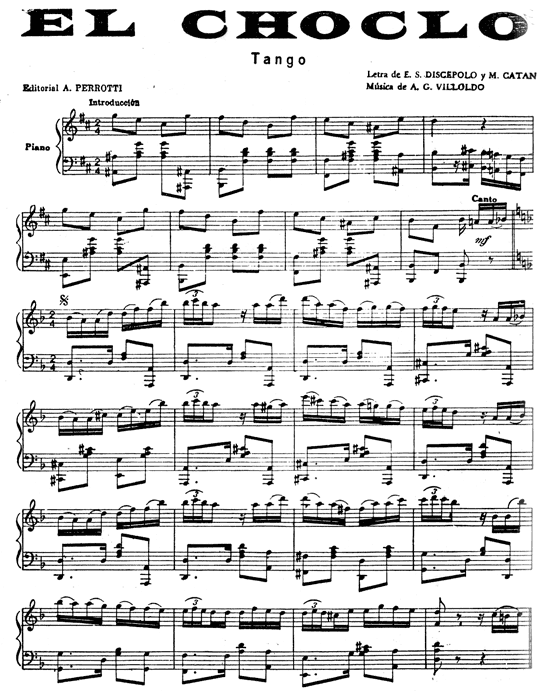
El choclo, tango criollo 1898 or 1903
Music, Casimiro Alcorta, Argentina
Arrangement, Ángel Villoldo, Argentina
Lyrics, (best version) Enríque Santos Discépolo, Argentina
Countless hands and minds contributed to the creation of this tango, now considered one of the most renowned and representative of the genre.
Its origins are said to trace back to Casimiro Alcorta, a prominent Afro-Argentine violinist and composer, the son of enslaved parents and himself freed as a child when he was given his former owner’s surname, as was customary at the time. It is also believed that José Luis Roncallo transcribed the current score of “El Choclo”, originally conceived by Ángel Villoldo, who, despite being unable to read or write music, had a remarkable talent for performing it. To avoid conflicts at El Americano, a prestigious restaurant in downtown Buenos Aires where the piece debuted during a time when tango was still associated with marginalized classes, the work was presented as a “criollo dance.”
In 1947, Enrique Santos Discépolo wrote one of the most famous lyrics for this iconic tango, further cementing its place in Argentina’s musical history.

Campo Afuera, milonga campestre 1939
Music, Rodolfo Biagi, Argentina
We have decided to record an instrumental version of this “milonga campestre” by Rodolfo Biagi, composer known as “Manos Brujas.”
The accompanying poem was written by Homero Manzi, placing the piece within that select group of songs that convey a sense of vengeance after a farewell — the classic breakup compositions tinged with bitterness. However, it is precisely the belief in shared suffering that allows the protagonist to regain their self-esteem, bringing a redemptive touch to the story.
These songs, far from being mere expressions of sorrow, achieve what many others cannot: offering emotional resolution. By breaking their bitter smile, they purify the air within their own musical world.
 flirtango orchestra